Ancient Alien Theories, Explained for Fun
Published 2026-11-18 by Abducted Apparel
Few ideas are as entertaining as the claim that visitors from space helped shape the ancient world. It makes for great late-night conversation and even better t-shirts. This guide explains where the theory came from, what its fans point to, and what historians and archaeologists say. We are here for the fun, not for a debate about the truth: the evidence says people built these wonders, and that is the better story anyway.
Where the idea began
Writers had suggested ancient contact before, but the idea became a pop-culture phenomenon in 1968 with Erich von Däniken's book Chariots of the Gods? He argued that monuments and ancient art could be explained by visits from advanced travelers. The book sold widely and inspired many documentaries, magazine articles and imitators. Scholars have long criticized its arguments for ignoring evidence about how ancient societies actually lived and worked.
The Anunnaki and Nibiru
In Sumerian and Akkadian writing, the Anunnaki are a group of gods. In 1976, author Zecharia Sitchin published The 12th Planet, claiming that these gods were space travelers from a hidden planet called Nibiru. Scholars of ancient languages disagree with his readings of the texts. The name Nibiru does appear in Babylonian writing, but as a name for a celestial body or crossing point, not a planet on a collision course. It has been a favorite of internet forecasts ever since, and none of them has come true. We have fun with it in Nibiru Is Running Late.
The pyramids
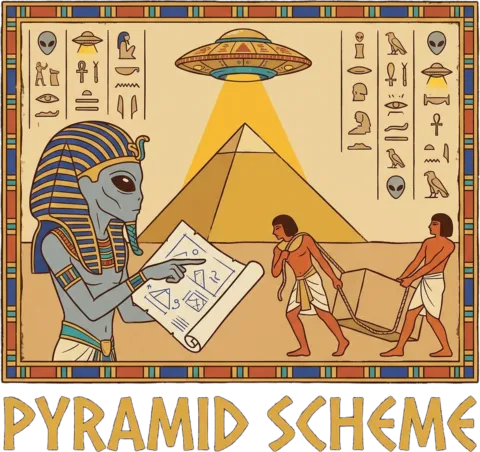
The Great Pyramid at Giza is the usual centerpiece. Fans of the theory point to its size and precision. Archaeologists point to evidence of the people who built it. The pyramid dates to about 2560 BC and was built for the pharaoh Khufu. In 2013, researchers at Wadi al-Jarf on the Red Sea coast found papyrus logbooks kept by an official named Merer, who recorded trips carrying limestone to Giza. Excavations near the pyramids also found a town with bakeries and housing for the workers. These details show a huge, organized project, and make a great story of human ingenuity. Our Pyramid Scheme design jokes about the scale.
Hieroglyphs and lost languages
Hieroglyphs looked like a mystery until the Rosetta Stone, discovered in 1799, helped Jean-Francois Champollion crack the code in the 1820s. Once people could read them, the texts turned out to be about kings, gods, farming, trade and daily life. They are not alien manuals, but they are packed with fascinating detail. Hieroglyphs Are Just Alien Receipts jokes that they are just receipts.
The Nazca lines and other favorites
The giant figures drawn in the Nazca desert in Peru are often cited as landing strips or signals for visitors. Researchers have shown that the lines can be made with simple tools such as stakes and cords, and they likely had ceremonial purposes. Similar explanations exist for many other sites that fans of the theory love. It is a good reminder that ancient people were skilled at planning, math and teamwork.
Puma Punku and precision stonework
Another favorite is Puma Punku in Bolivia, part of the Tiwanaku site, where finely cut stone blocks fit together with sharp corners. Archaeologists attribute the work to the Tiwanaku culture, which flourished in the Andes roughly between the fifth and tenth centuries AD, and show how skilled stonecutters could produce such blocks with tools of harder stone and a great deal of patience. The lesson repeats across sites: when something looks impossible, the real answer is often years of skill, labor and planning by people who left few written records.
How to tell a fun theory from a claim
A simple test helps. Ask what evidence is offered, whether experts in the field have reviewed it, and whether a more ordinary explanation fits the facts. A good theory can survive those questions. Many ancient-alien ideas do not, which is why we label our designs as jokes. The joke works best when everyone knows it is one.
Why the theory is so popular
The theory is appealing because it turns mystery into a story. It is also easy to share, and it makes people curious about history. The risk is that it can sell short the people who actually built these monuments, so many experts encourage fans to learn about the real cultures behind them. A good approach is to enjoy the questions, then follow them into museums, books and documentaries about the real past.
How to enjoy it
Treat the theory as folklore for the modern age. Read the original books for a sense of the debate, then read what archaeologists say. Visit a museum with an Egyptian or Mesopotamian collection. And if you like to wear your curiosity, browse our Ancient Alien and pyramid shirts. They are comedy designs, not claims, and they make good conversation starters.
For more, read our guide to gift ideas for cryptid lovers or explore our UFO and alien abduction shirts.