Sea Monsters of the World: Nessie, Ogopogo and More
Published 2026-11-18 by Abducted Apparel
Water has always been the best hiding place for monsters. Lakes are deep, oceans are huge, and what lies below is hard to see. That is why sea and lake monster stories show up around the world, from Scotland to Canada to the open ocean. This article is a friendly tour of the most famous ones, with the history and the skeptical view side by side. None of these creatures has been proven to exist, and we treat them as folklore.
Nessie of Loch Ness
Loch Ness in the Scottish Highlands is about 23 miles long and very deep, with dark, peaty water that makes it hard to see far below the surface. A medieval biography of Saint Columba describes a river beast in the area in the sixth century, but the modern legend began in 1933, when a newspaper in Inverness reported a large creature in the loch. A road had just been built along the shore, giving more people a view of the water, and interest exploded.
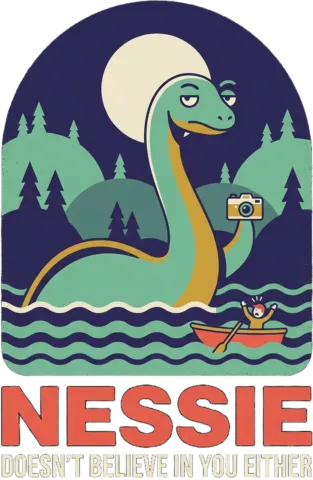
The most famous photograph, the 1934 Surgeon's Photograph, was later admitted to be a hoax made with a toy submarine and a sculpted head. In 2018, scientists sampled environmental DNA from the loch and found no sign of a large reptile, though they did find a great deal of eel DNA, which revived the idea that some sightings could be giant eels. Nessie remains beloved anyway. Our Nessie Doesn't Believe in You Either design gives the monster a skeptical expression, and Bad Pony, Great Swimmer, with a prize-winning kelpie, nods to the water-horse stories found elsewhere in Scottish folklore.
Ogopogo of Okanagan Lake
In British Columbia, Okanagan Lake is long, narrow and deep, and it has its own legendary resident called Ogopogo. The name comes from a 1920s English music-hall song, but the story is older. The Syilx people of the region tell of a powerful lake spirit, often called n'ha-a-itk, and travelers were traditionally careful when crossing certain parts of the water. Modern sightings describe a long, serpentine shape with humps. Skeptics point to floating logs, waves, otters and boat wakes. The town of Kelowna has a statue of the creature, which shows how much locals enjoy the legend.
Champ of Lake Champlain
Lake Champlain, shared by New York, Vermont and Quebec, has Champ, often described as a long-necked creature. Reports go back at least to the nineteenth century, and a famous claim that the explorer Samuel de Champlain saw the beast in 1609 is generally considered a myth. In 1873, the showman P. T. Barnum reportedly offered a reward for a sea serpent hide. Champ is now a mascot, and baseball fans in Vermont know it well.
The kraken
The kraken comes from Scandinavian sailors' tales. Old accounts describe a vast creature that could drag ships down, and in 1752 a Norwegian bishop wrote about it in a natural history. In 1830 the poet Alfred Tennyson gave it a famous poem. The legend likely grew out of sightings of giant squid, which are real. The giant squid can grow to over forty feet long including its tentacles, and for most of history it was known only from carcasses that washed ashore. A giant squid was first photographed in its natural habitat in 2004, and later filmed in the deep sea, which proves that the ocean really does hold surprises. Our Kraken Me Up and Deep Sea Grudge designs give the kraken plenty of personality, and Release Me has one reaching for a pirate ship.
Sea serpents
Sailors across the centuries have reported huge snake-like animals in the water. A well-known case is the 1848 sighting by the crew of the British ship HMS Daedalus, who described a long creature with its head raised above the waves. Explanations include oarfish, which are real deep-sea fish that can grow very long, along with whales, basking sharks, strings of seals and swimming kelp. Old maps even marked dangerous waters with sea serpents and warnings in the spirit of here be monsters, which inspired our Here Be Monsters design. For a woodblock take on the classic monster, see Sea Serpent, Zero Chill.
Why water monsters last
There are practical reasons these stories survive. Deep water hides things, so no one can easily prove a negative. Fog, distance and moving waves make shapes hard to judge. Tourism helps, too: towns near Loch Ness and Okanagan Lake welcome visitors who come to look. And for many people, the possibility of something unknown makes a day on the water feel more exciting.
Go see them for yourself
If you love the idea, a trip to Loch Ness or Okanagan Lake makes a good outing, with boat tours, museums and plenty of scenery. Take binoculars, a camera and a sense of humor. The best monsters are the ones that keep you scanning the horizon.
Browse the full sea monster collection for more designs, or keep reading with our Mothman legend article if you prefer your mysteries on land.