Bigfoot Sightings: The Most Famous Encounters
Published 2026-11-18 by Abducted Apparel
Bigfoot, also called Sasquatch, is the most famous cryptid in North America. People have told stories about large, hairy, human-shaped creatures in the forest for generations, and the modern legend took off in the middle of the twentieth century. In this article we walk through some of the best-known encounters, explain what is documented and what is disputed, and keep the tone light. No creature like this has ever been confirmed by science, so consider this a tour of folklore.
Before the name: old stories
Native peoples in the Pacific Northwest have long told stories about wild forest beings, and the word Sasquatch comes from a Halkomelem word that a Canadian writer, J. W. Burns, adapted for newspaper readers in the 1920s. Stories of wild men in the woods exist in many cultures, which is part of why the idea feels so familiar. These traditions are not all the same, and they should be treated with respect rather than flattened into a single monster tale.
1924: Ape Canyon
One of the earliest famous reports comes from near Mount St. Helens in Washington. In July 1924, a group of miners said that several large, ape-like creatures threw rocks at their cabin overnight. They said they fired at the figures and found huge footprints the next day. The event gave the area the name Ape Canyon. Skeptics suggest that the miners may have been the target of a prank, or that the noise came from falling rocks, but the story is still a classic.
1958: Bluff Creek and the name Bigfoot
The modern Bigfoot era is usually dated to August 1958. A bulldozer operator named Jerry Crew found enormous footprints around a logging site at Bluff Creek in northern California, and a local newspaper published the story and used the name Bigfoot. National coverage followed. Decades later, after the death of a logging contractor named Ray Wallace, his family said he had made fake tracks with carved wooden feet. Some researchers think that explains the 1958 prints, while others say it cannot account for every footprint report. It is a good reminder that hoaxes and honest mysteries often overlap.
1967: the Patterson-Gimlin film
On October 20, 1967, Roger Patterson and Bob Gimlin filmed a large, dark, long-armed figure walking across a clearing at Bluff Creek. The footage lasts under a minute, and it is still the most famous Bigfoot evidence ever shown. People have argued about it for decades. Some say the walk and the proportions look real, while others say it shows a person in a costume, and a man later claimed to have worn the suit. The film has never been proven either way to everyone's satisfaction, which is exactly why it remains famous. The blur and grain are part of the lore, and our Blurry for a Reason design jokes about it with a deliberately blurry Sasquatch. If you prefer a better-lit star, Trail Cam Supermodel gives Bigfoot a night-vision photo shoot.
1969: a county makes it law
In 1969, Skamania County, Washington, passed an ordinance that made it illegal to harm a Sasquatch. The measure was partly serious, aimed at protecting a possible animal, and partly a nod to the growing craze. Later laws turned it into a protection that still draws curious travelers.
The Fouke Monster and other regional legends
Bigfoot is not limited to the Pacific Northwest. In 1971, a family near Fouke, Arkansas, reported a large, hairy creature, and the story inspired a 1972 film, The Legend of Boggy Creek. Florida has its skunk ape, and several other states have local versions. If you like the idea of hiding from the crowds, our Social Distancing Champion design shows a Bigfoot who has perfected the art of distance.
What does science say?
Biologists point out that large animals need breeding populations, food and habitat, and that a population of giant apes would leave behind bones, scat and clear photographs. None has been found. Hair and tissue samples submitted over the years have turned out to come from known animals such as bears, deer or humans. Many scientists link the legend to bears standing on their hind legs, to misidentified tracks, and to hoaxes, together with the human tendency to see faces and figures in the woods. Still, the legend has real cultural value. It reminds us that the wilderness still feels big and mysterious.
Why we keep looking
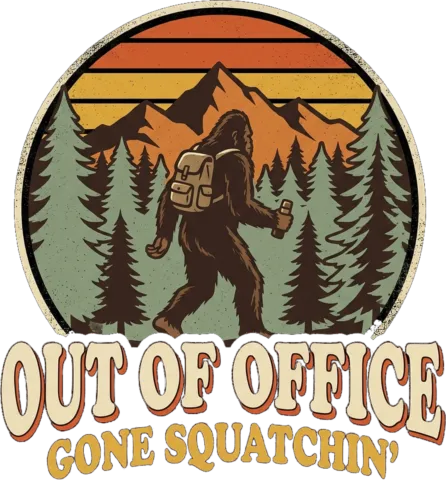
Bigfoot appeals because he stands for a part of the world that has not been fully mapped. He also makes a very good mascot for introverts. Our Out of Office design, with a Sasquatch on leave, is for anyone who wants to head into the forest and ignore their inbox. You can browse the full Bigfoot and cryptids collection for more, or read about other creatures in our guide to cryptids by state.
If you want to go looking yourself, remember to leave no trace, stay on marked trails, and never approach wildlife. The best encounter may simply be a quiet morning in the trees.